Why Lidar is Taking Over Smart Lawn Care?
The integration of advanced Lidar for robotic mower navigation represents the most significant technological leap in the automated lawn care industry. Often described as bringing "L4 autonomous driving" standards to your backyard, modern robotic mowers are leveraging high-resolution laser sensors to navigate complex landscapes with unprecedented safety and precision. This shift is not just an incremental upgrade; it is a fundamental transformation that solves the long-standing limitations of traditional camera and RTK-based systems.
The Problem with Traditional Sensors
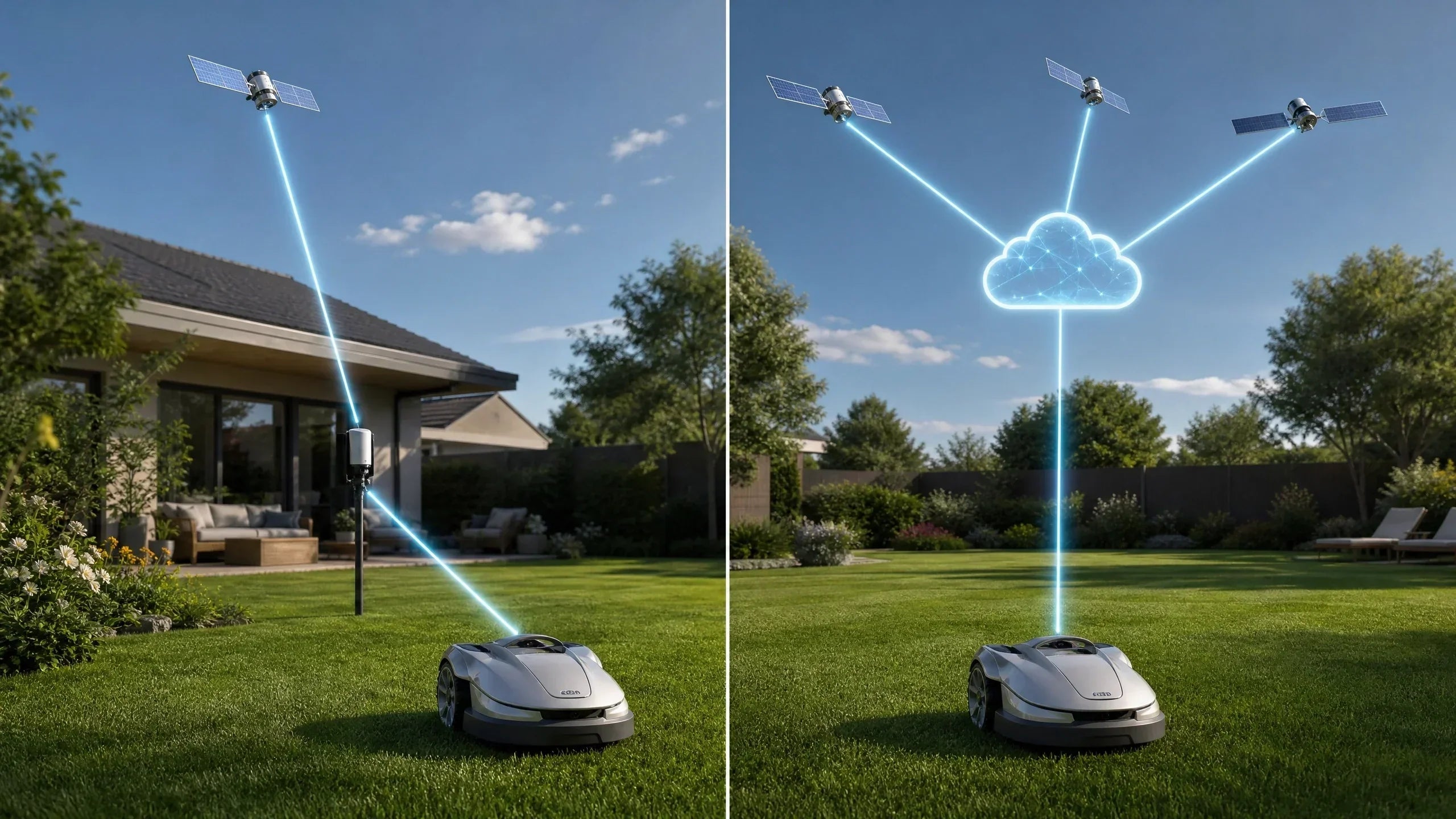
Just like a self-driving car navigating city streets, a robotic mower must perceive its environment, build a 3D map, avoid obstacles, and plan efficient paths without human intervention. However, traditional sensors struggle with the unique challenges of a backyard. Cameras rely heavily on visible light, meaning their effectiveness drops dramatically at night or in the deep shade of trees. Furthermore, low-resolution visual systems often miss tiny obstacles like garden toys, stones, or small animals. RTK systems, while accurate for positioning, require physical base stations and can lose signal when blocked by tall fences or dense foliage.
Why Lidar Outperforms Cameras (Especially at Night)
One of the most significant advantages of Lidar is its ability to function flawlessly regardless of lighting conditions. Instead of relying on light, Lidar uses laser pulses to measure distance, building a detailed 3D map of the environment by calculating the time it takes for light to bounce back. This means your mower can operate safely and efficiently at any hour, providing true 24/7 reliability.
Furthermore, high-line-count Lidar provides a clarity that low-resolution systems simply cannot match. While a standard sensor might miss a thin branch or a small pet hiding in the grass, a high-resolution system sees the world in fine detail, ensuring no obstacle is overlooked.
How Lidar Actually Works: The Science of Precision
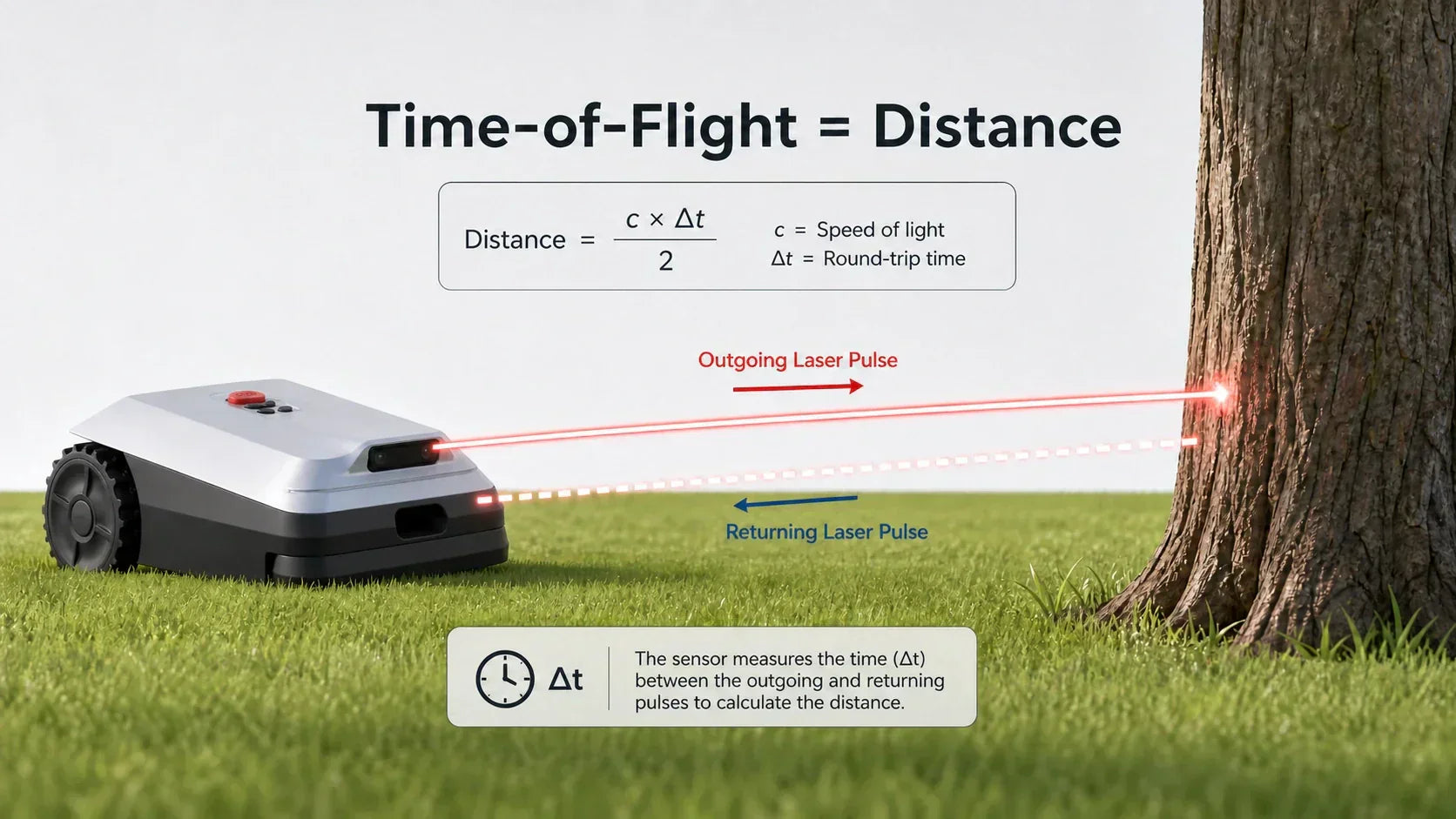
To truly understand why this technology is superior, it helps to look under the hood. Lidar (Light Detection and Ranging) operates on a principle known as Time-of-Flight (ToF). The sensor emits high-frequency, invisible laser pulses that bounce off objects in the yard and return to the receiver.

By precisely measuring the time it takes for each laser pulse to travel out and back, the system calculates the exact distance to every object it encounters. Combining this distance data with the angle of the laser beam, the mower’s onboard computer generates millions of 3D coordinate points per second. These points form a highly accurate "point cloud," which is essentially a real-time, three-dimensional digital twin of your backyard. This allows the mower to instantly recognize not just where an object is, but also its shape, size, and texture.
Built for the Elements: Durability & Longevity
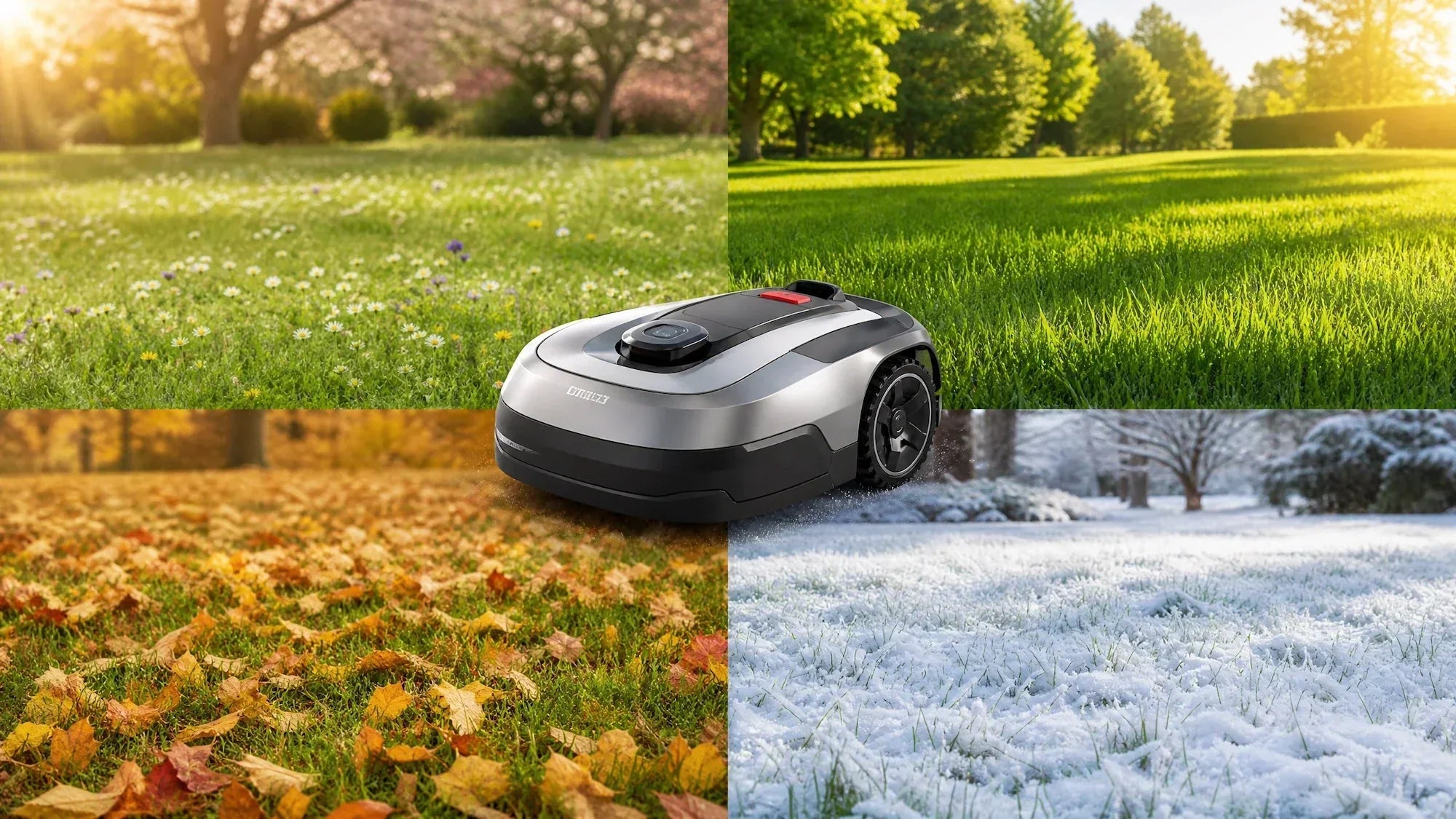
Outdoor robotics demand rugged hardware. A robotic mower operates in rain, snow, dust, and extreme temperatures, and is regularly hosed down for cleaning. This is why the best sensors for these machines are built to automotive-grade standards:
All-Weather Protection
With IP67 and IP6K9K ratings, these sensors are completely waterproof and dustproof, surviving high-pressure washes and heavy storms.
Extreme Durability
Tested to withstand vibrations and shocks, the solid-state design (with no spinning motors) ensures reliability even on the bumpiest lawns.
Long Lifespan
Designed for over 8 years of outdoor use, these sensors far exceed typical consumer electronics standards.
Choosing the Right Sensor
When evaluating a robotic mower, it is essential to look beyond just the brand. The quality of the sensor dictates the machine's intelligence. While long-range detection (over 30 meters) and wide field of view are standard, the true differentiator is resolution. Specifically, the vertical angular resolution determines how clearly the mower can see. A higher resolution means more lines and a sharper image, allowing the robot to detect small objects and changes in elevation with confidence.
Frequently Asked Questions (FAQ)
Q: Can Lidar sensors be damaged by heavy rain or fog?
A: Not at all. High-quality Lidar sensors are engineered with robust waterproof ratings (such as IP67). While extreme heavy rain or fog might slightly reduce the maximum detection range, the sensor continues to operate safely and accurately in all typical weather conditions.
Q: Is Lidar safe for pets and children in the yard?
A: Yes, it is completely safe. The laser pulses used in robotic mowers are Class 1, which is the safest classification for laser products. They are invisible, low-power, and pose no risk of harm to human eyes or animal vision.
Q: Does a Lidar robotic mower require a base station like RTK systems?
A: No. One of the biggest advantages of Lidar is its autonomy. It builds its own 3D map using its onboard sensors, meaning there is no need to install, calibrate, or maintain a physical base station or buried perimeter wires.
Q: How does Lidar handle complex terrain with slopes and cliffs?
A: Lidar excels in complex environments. By creating a precise 3D point cloud, it can accurately detect changes in elevation, such as slopes, ditches, or pool edges. This allows the mower to plan safe paths and avoid dangerous drops that traditional 2D sensors might miss.
Conclusion
The era of basic, wire-bound, or camera-limited mowers is fading. The integration of advanced Lidar for robotic mower technology represents a quantum leap in automation. By providing reliable 3D mapping, unbeatable night vision, and robust durability, Lidar empowers your mower to handle any yard, day or night. If you value a pristine lawn and total peace of mind, a Lidar-powered robotic mower is the ultimate investment in modern convenience.